The cell that hums: PEMF, the science of cellular recovery, and the four therapies that amplify it
Cells run on voltage. The membrane separating a cell's interior from the world around it carries a charge of about minus seventy millivolts — a small figure, until you consider that across that impossibly thin barrier it amounts to roughly forty million volts per metre. That is the kind of intensity you find inside a thundercloud.
The cell that hums: PEMF, the science of cellular recovery, and the four therapies that amplify it
On bioelectricity, the Earth's heartbeat, and the engineered stack that puts them all in one place.
A current of life
At this very moment, somewhere between your skin and your skeleton, an extraordinary number of cells are quietly engaged in the business of staying alive. The number, give or take, is around thirty-seven trillion. And every single one of them is a tiny electrical engineer.
Cells run on voltage. The membrane separating a cell's interior from the world around it carries a charge of about minus seventy millivolts — a small figure, until you consider that across that impossibly thin barrier it amounts to roughly forty million volts per metre. That is the kind of intensity you find inside a thundercloud.
Your body, in other words, is humming. It has been humming since you were a fortnight old in the womb, and it will continue to hum until the lights go out for good.
For most of human history, this was a state of affairs we knew almost nothing about. Galen — chief physician to Marcus Aurelius and arguably the most influential doctor in history — spent his life convinced that nerves were hollow tubes through which an invisible "animal spirit" flowed. He was magnificently wrong. Nearly everyone was, more or less continuously, until the eighteenth century.
This article is about how we figured it out, and what happens when you discover a new physical law and then, after a century of staring at it, work out you might be able to use it on yourself.
The result is called PEMF — pulsed electromagnetic field therapy. Depending on whom you ask, it is either the most underused tool in modern recovery science or the best-kept secret in cellular medicine. Probably both.
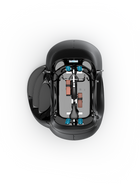
It is also, importantly, only one layer of the story. PEMF is one of five therapies engineered into the Helix PEMF Bed. The others — far-infrared heat, red and near-infrared light, vibroacoustic sound, and hot gemstone lava rock — are not decoration. Each speaks to your body through a different channel, and together they speak to far more of it than any of them could alone.
But to understand the stack, you have to start with the cell.

The body electric
For nearly two thousand years after Galen, the prevailing view was that nerves carried something subtle and ineffable — a kind of vital fluid that animated the body the way wind animates a sail. The idea persisted partly because nobody could think of a better one, and partly because the alternative — that life ran on something as crude as electricity — was unthinkable. Electricity was what struck unlucky shepherds in thunderstorms. It was not what made you decide to scratch your nose.
Then, in 1791, an Italian anatomist called Luigi Galvani noticed something peculiar. While dissecting a frog, he found that its detached leg twitched when touched with a metal scalpel resting near a static-electricity machine. He repeated the experiment many times, with great care, and concluded — correctly — that animals carried their own internal electricity.
His colleagues thought he was mad. He was not mad. He was almost exactly right.
Every action your body takes — moving a finger, lifting an eyebrow, deciding what to have for lunch — begins as a tiny voltage change across a cell membrane. Your nervous system runs on cascading electrical pulses moving at speeds of up to 120 metres per second. Your heart's rhythm is a coordinated wave of electrical depolarisation, fired by a small cluster of cells in the upper-right chamber called the sinoatrial node. Even your bones generate small electrical currents under stress — and that fact, as we'll see, is the unlikely entry point through which PEMF was discovered.
The mechanism, when you boil it down, is elegant. Each cell is a membrane-bound bag of saltwater, with potassium inside and sodium outside, kept that way by molecular pumps. At rest, the cell's interior is about seventy millivolts more negative than the world around it. Open the right gate, the ions rush in or out, the voltage flips for a thousandth of a second, and a signal is born.
You are, biologically speaking, an exquisitely tuned electrical system. So is your dog. So is the lettuce in your fridge. The difference is that you, unlike the lettuce, can do something interesting about it.
A short history of PEMF
By the time Galvani died in 1798, the world had a new word — galvanism — and a glimpse of a phenomenon nobody quite knew what to do with. For the next century the study of bioelectricity proceeded in fits and starts, mostly through experiments that involved poking small animals with various small electrodes.
The next leap came not from medicine but from a Serbian engineer with a flair for theatrics. Tesla — who arrived in America in 1884 with four cents in his pocket and a head full of equations — patented coils in the 1890s that produced "curative" high-frequency currents, and routinely passed enormous voltages through his own body to demonstrate that high-frequency electricity didn't kill you. A technique you should not, under any circumstances, try at home.
Tesla's claims were ahead of the science. They were not, however, wrong.
Decades later, in the 1960s, an American orthopaedic surgeon named Robert Becker began studying why salamanders could regrow severed limbs and humans, irritatingly, could not. The answer, he became convinced, lay in the small electrical currents the body produces during healing. Becker spent the rest of his career making the unfashionable argument that the body was, fundamentally, an electrical system. His 1985 book The Body Electric became a sleeper hit. The orthopaedic surgery community, which had spent two decades watching pulsed electromagnetic field devices heal stubborn fractures that nothing else could touch, knew he was onto something. The FDA approved PEMF for non-union bone fractures in 1979.
The unlikely accelerant came from above. In the early 1970s, NASA noticed astronauts returning from orbit with measurably weakened skeletons. Bones, it turned out, like to be loaded by gravity. In 2007, NASA published findings that pulsed electromagnetic fields tuned to particular frequencies dramatically upregulated genes involved in tendon, neural, and connective tissue repair. The science was abruptly serious.
Today PEMF therapy is FDA-approved for non-union bone fractures, depression, and brain tumours, and is used widely off-label for sleep, inflammation, and athletic recovery. It has gone, in other words, from the fringes to the football pitch. Becker would be pleased.

How it actually works
To understand how a magnetic field can affect a cell, you have to know what Michael Faraday worked out in 1831. Move a magnetic field, and you induce a tiny electrical current in any conductor it passes through. The current is small, the conductor doesn't have to be a wire, and — crucially — your body is a perfectly serviceable conductor. About sixty per cent saltwater, in fact, which makes you a slightly soggy version of a copper coil.
When PEMF coils pulse a magnetic field on and off many times a second, they create a tiny induced electrical current inside whatever tissue happens to be in the field. The current is far too small to feel. But it is precisely the kind of current that cells already use for everything they do.
This is the elegant part. Cells aren't passive recipients of these fields — they listen. Every cell membrane has voltage-sensitive ion channels: protein gates that open and close depending on the local electrical environment. Apply a small, structured electromagnetic pulse, and you nudge those channels to behave slightly differently than they would in a quiet field. Sodium moves. Potassium moves. Calcium — the body's universal signalling currency — moves. Inside the cell, downstream genes are activated. Inflammation pathways dampen. Mitochondria, the small organelles that produce ATP, work more efficiently.
The effect of all this, when the right frequencies and intensities are used, is what doctors politely call "cellular optimisation." In the lab it shows up as faster bone healing, lower inflammation markers, better mitochondrial output, and surprisingly large effects on sleep and mood.
The catch is that frequency matters. Different frequencies talk to different cellular processes — which is why PEMF devices are not interchangeable, and why the engineering matters as much as the physics.
The Earth's heartbeat
In 1952, a German physicist called Winfried Otto Schumann was teaching his students about the cavity formed between the Earth's surface and its electrically conductive ionosphere — an enormous spherical capacitor, about a hundred kilometres tall and forty thousand kilometres around — when one of them asked an obvious question. What frequency would such a cavity resonate at?
Schumann did the sums on the back of an envelope and got an answer: roughly seven and a bit hertz.
The next year, the answer was confirmed by direct measurement. The Earth, it turns out, hums. The fundamental resonance sits at about 7.83 Hz, sustained by the roughly fifty lightning strikes happening somewhere in the world's atmosphere every second.
This is where the story takes an unexpected turn. The dominant frequency of the human brain at the boundary between wakefulness and sleep is also about 7.83 Hz, sitting squarely within the theta band — the rhythm of deep meditation, intuitive insight, and the moments just before falling asleep. Whether life evolved within the Earth's electromagnetic field and tuned itself accordingly, or whether the coincidence is just a coincidence, is one of those questions science has not entirely answered. But it has noticed the symmetry.
Recordings from shielded chambers — Faraday cages, where the Schumann frequency cannot reach you — have shown that human subjects experience disrupted circadian rhythms, flatter mood, and impaired cognitive performance after extended deprivation. When researchers reintroduce a synthetic 7.83 Hz field, the symptoms improve.
It is a small finding, replicated across several studies, with one striking implication: the Earth's electromagnetic background isn't decoration. It is, very likely, part of the environment we are tuned to. Most modern PEMF protocols, the Helix Bed included, deliver frequencies at or near 7.83 Hz for exactly this reason.
Why PEMF is both recovery and longevity
Most therapies sit cleanly in one of two camps. Cold plunges, massage, sleep — these are recovery interventions. Resveratrol, rapamycin, hyperbaric oxygen — these are longevity interventions. PEMF is one of the few that genuinely belongs in both, because the mechanism it operates on is the same mechanism that drives both timescales.
On the recovery timescale, PEMF lowers inflammatory markers, accelerates the clearance of metabolic waste, improves circulation, and shifts the autonomic nervous system out of sympathetic dominance and into the parasympathetic state where the body actually repairs itself. Bones heal faster. DOMS clears sooner. Sleep deepens. The FDA recognised the bone-healing effect in 1979. Elite sports medicine programmes have used it for decades.
On the longevity timescale, the same interventions look different. Lower chronic inflammation means less inflammaging — the slow, low-grade inflammatory burden that is now understood to drive most age-related disease. Better mitochondrial function means more ATP, less reactive oxygen species, and slower accumulation of the cellular damage that defines biological ageing. Improved sleep architecture means more time spent in the nightly repair windows your body needs to maintain itself. ANS rebalancing means lower allostatic load.
Recovery is what you feel the next morning. Longevity is what you feel — or rather, what you continue to be able to do — twenty years from now. PEMF is one of the rare modalities where the same protocol does both jobs at once.
The Helix PEMF Bed delivers across 3–64 Hz, with eight intensity levels and a dynamic mix programme that cycles through the full range every one to two seconds. Lower levels (1–3) for nervous system reset and relaxation. Mid levels (4–6) for circulation and muscle recovery. Upper levels (7–8) for deep tissue regeneration and joint pain. The full spectrum, in other words, of what cells respond to.
That alone would be a serious piece of equipment. But the bed does not stop at PEMF.
The stack: four more therapies, one body
When the bed was engineered, the design brief was to layer therapies that approach the body's biology from different angles, so that the cumulative effect is greater than the sum of its parts. The technical name is synergistic stacking. The practical effect is that you step off a session feeling something specific — and quietly, distinctly, better than you walked in.
There are four further modalities. Each works through a different channel. Each, in different ways, ends up speaking to the same cellular machinery.
Red and near-infrared light · 660 nm and 850 nm
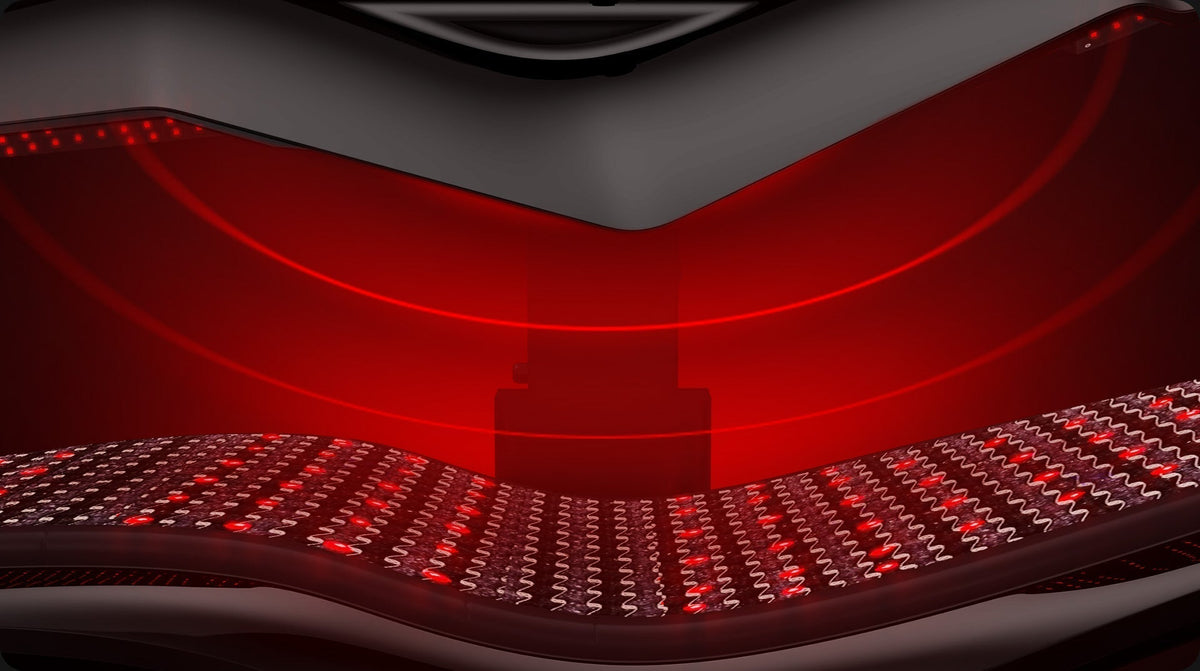
Light, despite appearances, is a frequency. The colour your eye perceives as red sits at around 660 nanometres on the electromagnetic spectrum — long enough to slip past the surface of your skin and reach the tissues beneath. Light at 850 nanometres, just past what your eye can register, goes deeper still.
Inside every mitochondrion sits an enzyme with the formidable name cytochrome c oxidase — the final station of the cellular energy assembly line. When red and near-infrared light strike this enzyme, they nudge it to work a little harder. The result is more ATP, reduced reactive oxygen species, and improved intracellular signalling. Your body has, in other words, evolved to thrive in red light.
At the skin, the 660 nm wavelength stimulates fibroblast activity — the cells responsible for producing collagen and elastin — measurably reducing fine lines and accelerating wound healing. Dermatology has embraced photobiomodulation as one of the few evidence-based non-pharmacological skin interventions available. At depth, the 850 nm wavelength penetrates muscles, joints, and connective tissue to reduce inflammation and speed repair. Athletes treated with PBM before training show delayed muscle fatigue, increased peak torque, and reduced post-exercise inflammatory markers.
The photobiomodulation research base now includes over six thousand peer-reviewed publications spanning forty years of investigation. The mechanism, you may have noticed, is the same one PEMF works through. Two doors into the same room.
Far-infrared heat · 6 to 14 microns
Far-infrared occupies a specific stretch of the electromagnetic spectrum, well past visible light, where the wavelengths are long enough to penetrate roughly three inches into tissue. Unlike a sauna, which heats the air around you, far-infrared heats you from within.
The effect is gentle, deep, and physiologically distinct. Blood vessels dilate. Microcirculation improves. Core temperature rises slowly — enough to trigger a cellular sweat that carries metabolic waste and heavy metals out through the skin. Heart rate increases mildly, mimicking some of the cardiovascular effects of light exercise. Heat shock proteins — molecular chaperones that repair damaged proteins and have been linked to longevity in multiple species — are upregulated.
In the context of the bed, far-infrared does work that PEMF and red light cannot. It operates at the tissue level, easing fascia, dilating vasculature, carrying inflammatory metabolites away. It is the layer that makes the room warm enough for the cell to do its best work.
Vibroacoustic sound · 30 to 120 Hz
Low-frequency sound waves, delivered through specialised transducers built into the bed, transmit mechanical vibration directly into the body. The effect is part audible, part felt, and part neurological.
Vibroacoustic therapy was developed in Norway in the 1980s and has been studied for fibromyalgia, arthritis, anxiety, and Parkinson's. The mechanism appears to combine several effects: mechanical stimulation of sensory receptors in muscle and fascia, neural entrainment of brainwave activity toward more relaxed states, and direct mechanical resonance with tissue. Stubborn knots release. The nervous system slows. Brain synchronisation deepens.
In the stack, vibroacoustic does something none of the other modalities does well: it works systemically, on the nervous system as a whole, and it works fast. It is the layer that allows the body to drop into the parasympathetic state where the other therapies do their best work.
Hot gemstone · natural lava rock
The mat itself is woven with natural lava rock, which both retains and emits heat exceptionally well and produces a low level of natural negative ions. Hot stone has been used in bodywork traditions for thousands of years for a reason that turns out to have a physiological basis: warm stone against the body sustains a level of localised heat that air or water cannot match, while the negative ion environment has been linked in several studies to improvements in mood and air quality.
It is, in the engineered context of the bed, the substrate on which the other four therapies sit. The layer that makes the surface feel like something you want to lie on for sixty minutes at a time, rather than something you have to endure.
Four mechanisms, four scales, one destination
Lay them out side by side and the elegance becomes clear.
PEMF works at the cellular scale — pulsing ion channels and supporting mitochondrial output through electromagnetic induction.
Red and near-infrared light work at the cellular scale too, but through a different door — photons absorbed by cytochrome c oxidase, boosting ATP synthesis directly.
Far-infrared heat works at the tissue scale — long-wave warming from within, dilating vasculature and easing fascia.
Vibroacoustic sound works at the systemic scale — mechanical waves shifting the autonomic nervous system into the state where repair becomes possible.
Four mechanisms. Four different scales. One destination.
The body is not a single problem to be solved. It is many systems running concurrently, in different time signatures, at different scales. A single therapy can speak to one of those systems beautifully. Four therapies, layered carefully, can speak to several at once. That is what the bed was built for: a structured, repeatable exposure to the conditions under which the body recovers.
From the inside out
If you have read this far, you have stayed with us through Galen's animal spirits, Galvani's frog, Tesla's coils, Becker's salamanders, and the disintegrating skeletons of orbiting astronauts. You have learned that you are humming with thirty-seven trillion tiny electrical engineers, that an ancient bacterium runs your energy economy, that the Earth itself is broadcasting at 7.83 hertz, and that your cells have been quietly waiting all this time for the right wavelength of red light.
It is, on reflection, an extraordinary set of facts to have learned about your own body. Most people never will.
The therapies on this bed — PEMF, red light, far-infrared heat, vibroacoustic sound, hot gemstone — are not the answer to everything. They are five well-understood levers you can pull on a system, your own body, that has spent every second of its life trying to maintain balance in an environment that increasingly does not want it to. Modern life is a slow erosion of the things bodies need: natural light, deep sleep, the planet's electromagnetic background, time to recover. This bed is one of several tools that can put a few of those things back.
At Helix, we engineered the PEMF Bed because we wanted the most effective version of these tools we could put in one place — whole-body PEMF, red and near-infrared light, far-infrared heat, vibroacoustic sound, and integrated hot gemstone lava rock, in protocols informed by the science.
We built it for our own performance. We sell it because we wanted other people to have access to the same.
That is, in a sentence, what Demand More means. Demand more from your recovery. Demand more from the science you trust. Demand more from the technology that promises to improve you. Demand more from your own attention to a body that is, after all, the only one you have.