
The Invisible Light
A sauna that warms you without heating the room — built on a colour of light no one can see, discovered by accident by the man who found Uranus.
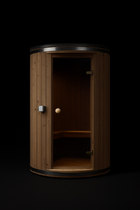
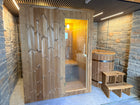
An infrared sauna is a quiet act of rebellion against the traditional Finnish kind. Where a conventional sauna heats the air around you to a punishing 80 or 90°C and lets that air heat you, an infrared cabin skips the middleman. It uses invisible infrared light to warm your body directly, so the air can sit at a far gentler 45 to 60°C while you still sweat as though you had sprinted for a bus. For anyone who finds a traditional sauna faintly like being cooked, this is a revelation.
The astronomer's accident
The whole thing rests on a discovery made by accident in 1800 by William Herschel — the astronomer who, nineteen years earlier, had found the planet Uranus. Herschel was splitting sunlight through a prism and laying thermometers along the resulting rainbow to see which colour carried the most warmth. On a whim he parked a spare thermometer just beyond the red end of the spectrum, in a patch of apparent darkness where no visible light fell, as a sort of control. To his astonishment it climbed higher than any of the colours. He had discovered a form of light the eye cannot see, which he called calorific rays, and his blackened thermometer bulb had just become the first infrared detector in history. Every infrared sauna is, in a sense, Herschel's experiment with a towel rail.
Passive cardio
Physiologically, sitting in radiant heat does something rather clever: it mimics gentle exercise. Your core temperature rises, your blood vessels dilate, your heart rate climbs and your cardiac output increases — much as they would on an easy jog, except you are sitting down. The key molecule is nitric oxide: heat stress prompts the lining of your blood vessels to produce more of it, and nitric oxide relaxes and widens those vessels, which can lower blood pressure and ease the load on the heart. The same heat also switches on heat shock proteins, the cell's internal repair crew.
What the evidence supports
The strongest heat evidence by far comes from traditional Finnish saunas, where decades-long cohort studies associate frequent use with substantially lower rates of cardiac and all-cause mortality. That is the weight of the science, and the reason our own range is built around traditional and barrel saunas. Infrared's own literature is younger but promising: a specific far-infrared protocol developed by the Japanese cardiologist Chuwa Tei — charmingly named Waon therapy, from the Japanese for soothing warmth — has been studied in supervised medical trials in patients with chronic heart failure. Those are studies in diagnosed patients under clinical care, not a claim about what a sauna will do for a general user. Small early trials have reported reductions in pain and stiffness among people with rheumatoid arthritis, and some symptom relief in fibromyalgia. These are small studies in diagnosed patients, not a claim that a sauna treats either condition. What deserves a raised eyebrow is the detox claim: yes, sweat carries trace amounts of metals and other compounds, but the robust, repeatable benefits of heat are cardiovascular and analgesic, not a great flushing-out of toxins.
It heats the body, not the room — a private sunrise, minus the sun.
The infrared difference
How to use it
Because the air is cooler, infrared sessions tend to run longer and gentler than a traditional sauna — commonly 20 to 40 minutes at 45 to 60°C, several times a week. Hydrate, come out if you feel unwell, and, as with any heat, keep it and alcohol well apart. The appeal is simple: much of the cardiovascular benefit of heat, at a temperature you can comfortably read a book in. For a commercial facility, though, our recommendation stays with the traditional sauna — the evidence is deeper and the experience is the one guests recognise.
- Laukkanen et al. — Association Between Sauna Bathing and Fatal Cardiovascular and All-Cause Mortality Events. JAMA Internal Medicine (2015).
- Tei et al. — Waon therapy improves the prognosis of patients with chronic heart failure. Journal of Cardiology (2008).
- Infrared sauna in patients with rheumatoid arthritis and ankylosing spondylitis. Clinical Rheumatology (2009).
- The Herschel Experiment — the 1800 discovery of infrared. Caltech Cool Cosmos.
Infrared sauna: the short version
The practical answers, pulled straight from the research above.
Is an infrared sauna as good as a traditional sauna?
Honestly, the evidence is deeper for traditional saunas. The strongest heat research comes from decades-long Finnish cohort studies (Laukkanen et al., 2015) on traditional saunas; infrared's own literature is younger but promising. That is why Helix supplies traditional and barrel saunas, not infrared cabins, for serious facilities.
How does an infrared sauna work?
Instead of heating the air to a punishing 80–90°C, an infrared cabin uses invisible infrared light, discovered by William Herschel in 1800, to warm your body directly. The air can sit at a gentler 45 to 60°C while you still sweat freely. It is, in a sense, Herschel's experiment with a towel rail.
What temperature and how long for an infrared sauna?
Because the air is cooler, infrared sessions tend to run longer and gentler than a traditional sauna, commonly 20 to 40 minutes at 45 to 60°C, several times a week. The appeal is much of the cardiovascular benefit of heat at a temperature you can comfortably read a book in.
What are the benefits of an infrared sauna?
Research suggests radiant heat mimics gentle exercise: core temperature rises, vessels dilate via nitric oxide, and heat shock proteins switch on. A far-infrared protocol called Waon therapy (Tei et al., 2008) has been studied in supervised trials in heart-failure patients. The much-hyped detox claim, though, deserves a raised eyebrow.
Is an infrared sauna safe?
For most people, used sensibly, yes. Hydrate, come out if you feel unwell, and keep heat and alcohol well apart. An infrared sauna is not a medical device. If you are pregnant or have a heart condition, speak to a clinician first. This is general information, not medical advice.
Last reviewed: October 2026 · Helix Science Lab. Figures reflect the cited research and may be updated as the evidence develops.