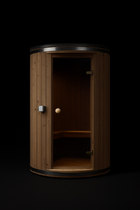

The Finnish Habit
A wooden room, a ladle of water and one of the most rigorously evidence-backed longevity habits on the planet — the improbable science of sitting very still, in the dark, in the heat.
There are about five and a half million people in Finland and, at the most recent sensible count, around three million saunas — roughly one for every household, and comfortably more than the country has cars. There are saunas in flats and factories, in fire stations and, at summer festivals, on the tops of Ferris wheels; there is one deep inside the Finnish parliament, and another at Finland's mission to the United Nations in New York, where generations of diplomats have conducted the gentle art of “sauna diplomacy” with their suits folded neatly outside. To a Finn the sauna is not a spa indulgence. It is simply where a civilised person goes to get clean, to think, and — for most of history — to give birth, to convalesce, and eventually to be washed one last time before burial. It was, as the old proverb has it, the poor man's pharmacy.
Two thousand years in a wooden box
The sauna is one of humanity's older ideas. The first were not rooms at all but pits dug into a slope, lined with stones, heated by fire and then covered over while the bather crouched inside in the warm dark — a close cousin of the sweat lodges found across the ancient world. By around a thousand years ago the Finns had refined this into the savusauna, or smoke sauna: a windowless log room with a great stone stove and no chimney whatsoever. You lit the fire, let it roar for hours until the stones glowed and the walls turned black with soot, cleared the smoke, and climbed in to enjoy the soft, enveloping heat it left behind. Purists — and Finland contains a very great many sauna purists — still insist the savusauna is the only sauna worth the name.
The chimney arrived in the sixteenth century, the metal stove in the nineteenth, and the electric heater in the 1950s, which is roughly when the sauna slipped its Finnish moorings and began its slow conquest of hotel basements everywhere. The word travelled too. “Sauna” is frequently described as the only everyday Finnish word to have entered common English — which, if true, means a nation of five million people gave the rest of us precisely one word, and had the good grace to make it a useful one.
What it actually does to you
Strip away the romance and a sauna is, physiologically, a small and beautifully controlled emergency. Sit in 80 to 100°C dry heat and your skin surface climbs toward 40°C, your core temperature rises a degree or two, and your body does what it always does when it overheats: it panics, elegantly. Vessels near the skin flush open, your heart rate climbs to 120, 130, sometimes 150 beats a minute, and your cardiac output roughly doubles. Which is to say a good sauna asks your cardiovascular system to do much the same work as a brisk walk — except you are sitting down, doing nothing, possibly half asleep. It is, gloriously, exercise for people who are not exercising.
This turns out to matter enormously, and we know it matters largely because of a group of middle-aged men in eastern Finland who have been quietly studied for the better part of forty years.
The Kuopio experiment
In the 1980s, researchers in the Finnish city of Kuopio recruited more than two thousand middle-aged men and, among a great many other measurements, asked them a very Finnish question: how often do you take a sauna, and for how long? Then they waited — for two decades. When the cardiologist Jari Laukkanen and colleagues published the results in JAMA Internal Medicine in 2015, the numbers were arresting enough to make the rest of the world put down its coffee. Compared with men who used the sauna once a week, those who used it four to seven times a week showed a 63% lower rate of sudden cardiac death, and around half the rate of cardiovascular death of any kind, across the twenty years that followed. Crucially, the benefit deepened the more often — and the longer — they sat in the heat: the tell-tale dose-response curve that makes scientists lean forward in their chairs.
Later work from the same cohort tied frequent sauna use to lower blood pressure, less arterial stiffness and — most intriguing of all — a markedly lower observed rate of dementia and Alzheimer's disease, again with a clean dose-response relationship. None of this, on its own, proves the sauna is doing all the work; men who sauna daily may simply lead gentler, more Finnish lives. But the sheer size and consistency of the effect has been enough to launch a whole field of proper clinical research into what heat does to the body.
The misfolded-protein cleanup
The most compelling mechanism is also the most elegant. Heat-stress a cell and it begins manufacturing a family of molecules with the thoroughly unglamorous name of heat shock proteins — molecular chaperones whose entire job is to grab misfolded, tangled, malfunctioning proteins and either fold them back into shape or haul them away to be recycled. A single sustained session can keep that repair crew switched on for up to two days afterwards. This is quietly fascinating, because several of the conditions we most dread in old age — Alzheimer's chief among them — are, at bottom, diseases of misfolded proteins accumulating where they shouldn't. A habit that routinely calls out the body's own protein-repair team is, at the very least, an interesting thing to own. Heat also nudges up BDNF, a growth factor that keeps neurons healthy and adaptable — the very molecule exercise is celebrated for raising.
A good sauna asks your heart to do the work of a brisk walk — while you sit in the dark and do nothing at all.
The exercise-mimicry effect
How to actually use one
The research points, reassuringly, at more or less what Finns have done on instinct for centuries. The cardiovascular data is strongest at 15 to 20 minutes, at 80 to 100°C, ideally four or more times a week. Hydrate. Come out when you feel unwell rather than heroic. And — this part the studies don't measure, though every Finn knows it — the point is not to endure the heat grimly but to enjoy it, ideally chased with something cold and a spell of doing absolutely nothing. Alcohol and saunas, it should be said, are a genuinely hazardous pairing, and best kept firmly apart.
What the evidence really says is this: heat, taken regularly, is not a wellness fad bolted onto modern life. It is one of the oldest health practices we possess, it happens to be backed by some of the best long-term data in the entire field, and a nation of five million people has been running the experiment — happily, and with great conviction — for two thousand years.
- Laukkanen et al. — Association Between Sauna Bathing and Fatal Cardiovascular and All-Cause Mortality Events. JAMA Internal Medicine (2015).
- Laukkanen, Laukkanen & Kunutsor — Cardiovascular and Other Health Benefits of Sauna Bathing: A Review of the Evidence. Mayo Clinic Proceedings (2018).
- Kunutsor & Laukkanen — Sauna bathing and the risk of dementia: evidence from the KIHD cohort.
- UNESCO — Sauna culture in Finland, Intangible Cultural Heritage of Humanity (2020).
Traditional sauna: the short version
The practical answers, pulled straight from the research above.
How hot should a sauna be?
The cardiovascular research is strongest at 80 to 100°C, for sessions of 15 to 20 minutes. At that heat your skin surface climbs toward 40°C and your core rises a degree or two. Stay hydrated, and come out when you feel unwell rather than trying to tough it out.
How often should you use a sauna?
Research suggests more is better. In the Kuopio cohort (Laukkanen et al., JAMA Internal Medicine, 2015) the benefit deepened with frequency, following a clear dose-response. Four or more sessions a week, at 15 to 20 minutes each, is broadly where the strongest associations sit.
Is a sauna good for your heart?
Research suggests a strong association. A good sauna asks your heart to do work much like a brisk walk, with heart rate climbing to 120–150 and cardiac output roughly doubling. In the Kuopio cohort, frequent use was associated with a 63% lower rate of sudden cardiac death over 20 years.
What does a sauna do to your body?
Heat opens the vessels near your skin and raises your heart rate, mimicking light exercise. It also switches on heat shock proteins, the body's own protein-repair crew, for up to two days, and nudges up BDNF, a growth factor linked to healthy neurons. These are associations, not guarantees.
Is using a sauna safe?
For most people, yes. Hydrate, keep sessions moderate, and come out when you feel unwell. Alcohol and saunas are a hazardous pairing, best kept apart. A Helix sauna is not a medical device. If you are pregnant or have a heart condition, speak to a clinician first. This is general information, not medical advice.
Last reviewed: October 2026 · Helix Science Lab. Figures reflect the cited research and may be updated as the evidence develops.