
Walking in a Vacuum
Low-effort exercise inside a sealed pod that pulls blood where you want it — a clever circulation idea wrapped around a fat-loss claim that deserves a careful eye.
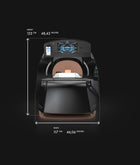
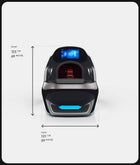
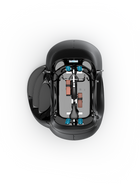
Of all the machines in the modern recovery studio, vacuum training looks the most like a spacecraft. You climb into a sealed pod or treadmill chamber, seal it around your waist, and walk or cycle gently while the pressure around your lower body cycles between vacuum and compression, often with infrared heat added for good measure. The premise is genuinely clever, the physiology is plausible, and the headline claim — targeted fat loss — is the part that deserves a careful, honest eye.
An Austrian's frustration
The method was born of a specific irritation. Dr Norbert Egger, a Salzburg-trained sports scientist, opened Austria's first women's fitness studio in 1983 and kept meeting members who trained hard and ate carefully yet could not shift fat from particular areas — hips, thighs, stomach. Convinced the problem was circulation rather than effort, he assembled a team of scientists and mechanical engineers to build a machine that, by the company's account, applied pressure therapy and fat-burning exercise at the same time for the first time. A 1997 trial of 530 women was encouraging enough that the device, HYPOXI, went into production that year and has since spread to more than fifty countries.
Pulling blood to the problem
The idea rests on a real piece of physiology: fat is mobilised fastest from tissue that is best supplied with blood. When you exercise, you release fatty acids from your fat stores — but the poorly circulated areas people most want to slim are exactly the ones least served by blood flow. Vacuum training tries to solve this mechanically: the alternating negative pressure and compression actively pull blood into the skin and the fat just beneath it, in theory so that the fatty acids liberated by the gentle exercise are drawn preferentially from those stubborn regions. The infrared heat adds further vasodilation. It is an ingenious attempt to aim exercise at a target the body usually chooses for itself.
Where the honesty is required
This is where a premium, evidence-based view has to be straight with you. Unlike hyperbaric oxygen or red light, whose benefits rest on independent, peer-reviewed research, vacuum training's targeted-fat-loss claims lean heavily on manufacturer studies, and robust independent trials are hard to find. Spot reduction — slimming one specific area by working it — is a contested idea in exercise science generally. The circulation and lymphatic-drainage effects are real and plausible, and many users value the low-impact cardio and the sense of improved leg circulation. But the bold body-shaping promises should be read with the same scepticism you would bring to any claim that outruns its independent evidence.
A genuinely clever circulation idea — wrapped around a fat-loss claim the independent evidence has not yet caught up with.
Promise versus proof
How to use it
Used sensibly, it is a pleasant, low-impact way to do gentle cardio while improving lower-limb circulation, and there is little risk in it. Approach it for what is well supported — easy movement, better blood flow, a comfortable warm session — rather than as a guaranteed route to spot-reducing fat, and it can sit happily inside a broader active-recovery routine.
Vacuum training: the short version
The practical answers, pulled straight from the research above.
What is vacuum training?
Vacuum training means exercising gently inside a sealed pod or treadmill chamber while the pressure around your lower body cycles between vacuum and compression, often with infrared heat added. It was developed in Austria by Dr Norbert Egger, whose HYPOXI device went into production in 1997, and the idea is to direct blood flow while you move.
Does vacuum training work?
For gentle, low-impact cardio and a sense of improved lower-limb circulation, it is well supported, and many users value it. The bolder targeted fat-loss claims are another matter: they lean heavily on manufacturer studies, robust independent trials remain thin, and spot reduction is contested in exercise science. We would read those promises with healthy scepticism.
What is vacuum training good for?
It suits easy, low-impact cardio while improving circulation in the legs. The alternating negative pressure and compression, plus infrared heat, genuinely draw blood into the skin and the tissue beneath, and the lymphatic-drainage effects are plausible. Approach it as a comfortable, warm active-recovery session rather than a guaranteed route to spot-reducing fat.
What is the HYPOXI method?
HYPOXI is the original vacuum-training device, built by Dr Norbert Egger's team of scientists and engineers and in production since 1997, after a founding trial of 530 women. The name nods to hypoxi-therapy, the idea of manipulating local blood and oxygen supply to a tissue. It has since spread to more than fifty countries.
Is vacuum training safe?
Used sensibly, it is a pleasant, low-impact session with little risk, and it sits happily inside a broader active-recovery routine. The equipment is not a medical device and makes no disease treatment claims. If you have a heart or circulatory condition, another health concern, or are pregnant, check with a clinician first. This is general information, not medical advice.
Last reviewed: October 2026 · Helix Science Lab. Figures reflect the cited research and may be updated as the evidence develops.