How to Sleep in a Heatwave: What the Science Actually Says
Why heat blocks sleep, why a warm shower cools you down, and what the evidence really says about cold plunges before bed. A practical UK heatwave sleep protocol.
To fall asleep, your core body temperature has to drop by roughly 1–2°C, and it is the speed of that drop that triggers sleep onset. A hot bedroom does not simply make you uncomfortable — it physically blocks the signal. The most effective heatwave sleep strategy is therefore not to chill your skin, but to help your body dump heat: a warm shower about 90 minutes before bed (which sounds wrong, but shortens time-to-sleep by around 36%), a bedroom cooled during the day rather than at bedtime, cooling of the hands, feet and face, and — contrary to popular advice — full-body cold immersion, which the available evidence associates with more deep sleep, not less.
Why does heat stop you sleeping?
Sleep is not purely a decision made in the brain. It is, to a surprising degree, a thermal event.
In the hours before sleep, your circadian system begins lowering your core temperature. It does this by widening the blood vessels in your hands and feet, pushing warm blood to the surface so heat can escape into the room. This is why cold feet keep people awake: if the body cannot offload heat, the core temperature does not fall, and the sleep signal never fully fires.
Research on sleep and thermoregulation consistently finds that the likelihood of falling into deep, non-REM sleep is highest when the rate of core temperature decline is at its steepest. In a hot bedroom, that decline is flattened. You are not bad at sleeping. You are thermally jammed.
What actually happens to your sleep in a heatwave?
Two things, and one of them is genuinely strange.
During REM sleep, you cannot sweat or shiver
In REM — the dreaming stage — the body's thermoregulatory control is largely suspended. You temporarily lose the ability to sweat or shiver, meaning you cannot defend your body temperature at all. In a hot room, the brain appears to respond sensibly: it reduces REM rather than allow you to overheat while defenceless. Reviews of the temperature dependence of sleep report that heat exposure increases wakefulness and reduces both REM and slow-wave sleep, with ambient temperatures above roughly 24°C associated with meaningful reductions.
Deep sleep is compressed hardest
Slow-wave sleep — the restorative stage most associated with physical recovery — appears to be the most heat-sensitive. A room that is too warm prevents the body from reaching the low core temperature that deep sleep requires. The result is a night that looks long on paper and feels worthless in the morning.
The scale of this is not trivial. A 2022 study published in One Earth, using wristband data from tens of thousands of people across 68 countries, estimated that warm night-time temperatures already cost the average person in the region of 44 hours of sleep per year, along with roughly 11 additional nights of insufficient sleep.
Should you take a hot or cold shower before bed?
Warm. This is the single most counterintuitive — and best-evidenced — item on the list.
A systematic review and meta-analysis of 17 studies (Haghayegh and colleagues, Sleep Medicine Reviews, 2019) found that passive body heating — a warm bath or shower at roughly 40–42.5°C for at least 10 minutes, taken about one to two hours before bed — was associated with a reduction in sleep onset latency of approximately 36%.
The mechanism is the point. Warm water drives blood into the hands and feet. These are covered in glabrous skin — hairless skin, unusually rich in specialised blood vessels that exist specifically to dump heat. Warming them opens the radiators. Heat then pours out of the body, and your core temperature ends up lower than if you had done nothing at all. You feel warm; you are, in fact, cooling faster.
A brief cold shower does close to the opposite. It chills the skin, triggers vasoconstriction that shuts those radiators, and produces an alerting response — without meaningfully lowering your core temperature. Excellent at 7am. Unhelpful at 11pm.
Does a cold plunge before bed help or hurt sleep?
Here the popular advice and the published evidence part company, and it is worth being precise, because a cold shower and a cold plunge are not the same intervention.
The usual argument against evening cold exposure runs like this: cold immersion sharply raises noradrenaline, noradrenaline is alerting, therefore cold before bed must impair sleep. It is a reasonable-sounding mechanism. It is also largely theoretical.
When researchers have actually measured sleep after evening cold-water immersion, the findings point the other way. A study of well-trained endurance runners published in Frontiers in Sports and Active Living (Chauvineau et al., 2021) examined the effect of immersion depth on sleep architecture. It reported that full-body immersion increased the proportion of slow-wave sleep during the first 180 minutes of the night compared with partial immersion, and that immersion significantly reduced arousals across the night compared with a control condition, with full-body immersion also reducing limb movements.
Why immersion behaves differently: the afterdrop
Unlike a shower, full-body immersion transfers heat out of the body at scale and genuinely lowers core temperature. Then, once you get out, the rewarming process drives blood back to the skin — and heat continues to leave the body. Core temperature keeps falling after the plunge has ended. That continued fall is precisely the physiological signal that initiates sleep.
In other words, a plunge does not fight your sleep drive. Done properly, it mimics it.
The honest caveat
Individual variation is real. A minority of people find cold exposure genuinely stimulating and will sleep worse if they plunge close to bedtime; those people should simply move the session two hours earlier, which also brings a heatwave bonus — an early-evening plunge lowers your core temperature going into the hottest, most uncomfortable part of the day. But if you plunge at night and sleep unusually well afterwards, you are not imagining it, and there is no good reason to stop.
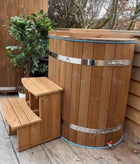
If you are considering cold immersion at home, the Helix Ice Bath holds a stable, chiller-controlled temperature every night rather than relying on melting ice, which matters if you intend to make it a nightly habit. Cold-water immersion is associated in peer-reviewed research with effects on recovery, mood and sleep architecture, though individual results vary and no outcome is guaranteed.
How should you cool your bedroom?
Most people begin cooling the bedroom at 11pm, by which point the walls, floor and furniture have been absorbing heat for nine hours and are radiating it back at you. The battle is won during the day.
| Lever | What to do | Why it works |
|---|---|---|
| Target temperature | Aim for roughly 16–19°C | Outside a band of about 15–24°C, sleep fragments and REM and deep sleep decline |
| Blackout early | Curtains and windows shut while the sun is on the room; open them once it is cooler outside than in | Stops thermal mass absorbing heat you then have to remove at night |
| Fan placement | Move air across the room and the bed, ideally creating a cross-breeze — not blasting your face | Air movement over skin drives evaporative cooling across the whole body |
| Bedding | Breathable natural fibres; one foot out of the duvet | An exposed foot is a working heat radiator, not a quirk |
Cool the right 3% of your body
Because heat leaves the body preferentially through glabrous skin, targeted cooling of the palms, soles and face is disproportionately effective. Sixty seconds of cold water over the wrists and ankles, or a cool damp flannel on the face, will do more for your core temperature than an hour of fanning your chest. It is the same physiology as the warm shower, approached from the other direction.
Which sleep supplements actually help in the heat?
Most are oversold. One has a mechanism that is specifically relevant to a heatwave. The following is general information, not medical advice — speak to a clinician before starting any supplement, particularly if you take medication.
- Glycine (around 3 g, 30–60 minutes before bed). The interesting one. Controlled trials have associated 3 g of glycine before bed with faster sleep onset, improved subjective sleep quality and reduced next-day fatigue. The proposed mechanism is directly thermal: glycine increases blood flow to the extremities and has been associated with a modest fall in core body temperature. That is exactly the lever a heatwave takes away from you.
- Magnesium bisglycinate. Reasonable but modest evidence for sleep quality in people who sleep poorly. Bisglycinate is generally the better-absorbed, better-tolerated form. High doses can cause gastrointestinal upset.
- Melatonin. Widely misunderstood. It is a circadian timing signal, not a sedative. It is useful for shifting a body clock — after travel, for instance — but it will not lower your temperature and will not solve a hot bedroom.
- Tart cherry. Pleasant, popular, and supported mainly by small trials, several of them industry-funded. Not a foundation to build a protocol on.
Can you train your body to cope with heat?
Yes — and this is the part most heatwave advice misses entirely. Heat tolerance is trainable, and the adaptations are measurable.
Repeated heat exposure, including sauna-based protocols, drives a set of physiological adaptations collectively known as heat acclimation. Research in this area reports expansion of plasma volume (commonly cited in the region of 5–12%), earlier onset of sweating, a higher sweat rate, and reduced cardiovascular strain during heat stress. Most of the plasma volume gain appears within the first five to ten sessions.
Practically, this means an acclimated body starts cooling itself sooner and at a lower core temperature. Habitual sauna users tend to report coping more comfortably with hot weather — which is the quiet joke at the centre of this article: some of the people handling the heatwave best are the ones who have spent the year voluntarily sitting in a hot wooden box.
If you want to build that adaptation, the Solstice traditional sauna range and the wider Helix heat collection are the place to start. Note that heat acclimation is a training effect built over weeks — it is not something to begin in the middle of a heatwave, and you should not use a sauna if you are already heat-stressed, dehydrated or unwell.
A practical heatwave sleep protocol
Assembled into an evening, it looks like this. Adjust the clock to your own bedtime.
| Time | Action |
|---|---|
| Through the day | Curtains and windows closed against direct sun. Open up once it is cooler outside than in. |
| ~2 hours before bed | Warm shower or bath, about 10 minutes — or a full-body cold plunge. Both routes end in a falling core temperature. |
| ~1 hour before bed | Glycine, if you use it. Magnesium bisglycinate if it suits you. |
| ~30 minutes before bed | Fan set to move air across the bed. Window open if the outside air is cooler. |
| ~15 minutes before bed | Sixty seconds of cold water over wrists, ankles and face. |
| Lights out | Light, breathable bedding. One foot out of the duvet. |
FAQ
What is the best bedroom temperature for sleep?
Most evidence points to a range of roughly 16–19°C for the majority of adults. Outside a wider band of about 15–24°C, sleep tends to fragment and both REM and slow-wave sleep decline.
Is a cold shower before bed a good idea in hot weather?
A brief cold shower cools the skin and triggers an alerting response without meaningfully lowering core body temperature, so it is generally less effective than a warm shower for helping you fall asleep. This is distinct from full-body cold immersion, which does lower core temperature and has been associated with increased slow-wave sleep.
Can I take an ice bath right before bed?
The available evidence on evening full-body cold-water immersion is broadly favourable, with one study reporting increased slow-wave sleep in the first three hours of the night and fewer arousals. Some people, however, find cold exposure stimulating and sleep better if they plunge earlier in the evening. Individual responses vary, so test it on yourself.
Why do I sleep so badly in a heatwave even when I am exhausted?
Because sleep onset depends on your core temperature falling, and heat prevents that fall. In addition, your body cannot regulate its temperature during REM sleep, so a hot room tends to suppress REM and deep sleep specifically — leaving you technically asleep but poorly recovered.
Does a sauna help you cope with hot weather?
Regular heat exposure produces heat acclimation, associated with expanded plasma volume, earlier sweating and lower cardiovascular strain in the heat. These adaptations build over weeks of consistent exposure, so a sauna is a long-term preparation strategy rather than an emergency fix during a heatwave.
Does putting a foot out of the duvet actually work?
Yes. The soles of the feet are covered in glabrous skin, which is specialised for heat exchange. Exposing a foot gives your body a functioning radiator, which supports the fall in core temperature that sleep depends on.
The short version
Sleep is a temperature event. Heat blocks it, and it blocks the most valuable stages first. Cool the room during the day rather than at bedtime, use warm water — or genuine full-body cold — to accelerate heat loss before bed, cool your hands, feet and face rather than your chest, and treat supplements as a small final adjustment rather than the plan. Then, when the weather breaks, build the heat tolerance that makes next summer easier.
Explore the Helix Sleep collection, the Helix cold therapy range and the Helix heat range, or contact the Helix team on sales@helixhpt.co.uk to talk through what would actually suit your space.
This article is general information about sleep and recovery, not medical advice. If you have a heart condition, are pregnant, or have any medical condition affected by heat or cold exposure, speak to a qualified clinician before using a sauna or cold-water immersion.