Contrast Therapy (Hot & Cold): What the Science Says, and How to Set It Up
Sauna, then plunge, then back again — contrast therapy is one of recovery's most pleasurable rituals. An honest, warmly told look at what alternating hot and cold actually does to the body, why the popular "pumping" explanation is shakier than it sounds, what the recovery evidence really shows, and how to set it up sensibly at home or commercially with a sauna and an ice bath.
There is a specific kind of gasp that escapes a person who has just walked, pink and steaming and thoroughly pleased with themselves, straight out of a hot sauna and into a tub of near-freezing water. It is not a dignified sound. It is the noise of a body that was, until about half a second ago, entirely convinced it had the situation under control. And yet people do this on purpose, over and over, and climb out grinning. The sauna-then-plunge ritual — hot, then cold, then hot again — has become one of the great pleasures of the modern recovery floor, and like most great pleasures it comes wrapped in a good deal of confident-sounding science that deserves a closer look.
Contrast therapy is simply the practice of alternating heat and cold: a spell in a sauna or hot bath, then a cold plunge, repeated a few times. It feels wonderful, which is exactly the sort of thing that should make a sensible person check the evidence before reaching for the word "detox". So let's do that — honestly — before we get to the business of setting one up.
What the body actually does when you alternate hot and cold
Take the two halves separately first, because each is better understood on its own than in combination. Heat is a genuine cardiovascular workout of sorts. In a sauna, your skin blood vessels dilate, your heart rate climbs, and blood is redistributed towards the surface to shed heat — responses that look, from the heart's point of view, a little like moderate exercise. The largest body of long-term evidence here comes from a Finnish cohort of over 2,000 middle-aged men, in which frequent sauna bathing was associated with lower cardiovascular and all-cause mortality over two decades of follow-up (Laukkanen et al., JAMA Internal Medicine, 2015). It is observational — it shows an association, not proof that the sauna caused it — but it is a serious, large study, and the physiological effects of heat on the circulation are real and well-described.
Cold does the opposite at the skin. The moment you plunge, surface blood vessels clamp down (vasoconstriction), heart rate and blood pressure spike, and you get the involuntary gasp of the cold shock response. Alternate the two, the theory goes, and you set up a rhythmic widening and narrowing of the blood vessels — and this is where the folklore begins.
The famous "pumping" claim — and why to be sceptical of it
You will hear, almost everywhere contrast therapy is sold, that switching between hot and cold makes your vessels alternately dilate and constrict, creating a "pumping" action that flushes metabolic waste out of tired muscles and draws fresh blood in. It is a lovely, intuitive image. It is also far more confidently stated than the evidence supports.
The trouble is that for this pump to do anything to a muscle, the temperature swings would have to reach the muscle — and they largely don't. When researchers actually inserted probes into people's calf muscles during contrast treatment, they found the deep tissue temperature barely moved. One study reported that contrast therapy changed intramuscular temperature by a fraction of a degree, far less than heat alone, and concluded it was "incapable of producing any significant physiological effect" on the muscle temperature a centimetre below the skin (Myrer, Draper & Durrant, Journal of Athletic Training, 1994). A separate team, measuring deeper still, found contrast therapy "does not cause fluctuations" in gastrocnemius muscle temperature, reasoning that a typical one-minute cold dip simply isn't long enough to shift deep tissue after the heat (Higgins & Kaminski, Journal of Athletic Training, 1998). If the temperature isn't swinging down there, the dramatic vascular "pump" being sold to you isn't happening down there either. The effect is real at the skin; the claim that it mechanically wrings waste out of your muscles is, at best, unproven.
What the recovery evidence actually shows
So does it help you recover? Here the honest answer is: a little, and mostly in how you feel. The most direct evidence comes from a systematic review and meta-analysis that pooled eighteen trials of contrast water therapy after hard exercise. It found that contrast therapy did reduce muscle soreness and limit strength loss in the day or two afterwards compared with simply doing nothing — a real, if modest, benefit (Bieuzen, Bleakley & Costello, PLOS ONE, 2013). That is the good news, and it is worth having.
The deflating part is the comparison. When the same review measured contrast therapy against other active recovery methods — including cold-water immersion on its own — it found no meaningful difference. Contrast was no better than the alternatives, and the authors were careful to note that every included trial carried a high risk of bias. The large Cochrane review of cold-water immersion reached a similar verdict from the other direction: pooling the trials that compared plain cold immersion with alternating hot-and-cold, it found no difference in soreness between them (Bleakley et al., Cochrane Database of Systematic Reviews, 2012). In other words, the contrast part — the alternating, the "pumping" — doesn't appear to add much over just getting cold.
So what are you left with? A recovery practice that reliably makes people feel less sore and less wrecked, performs about as well as its simpler cousins, and comes with the considerable bonus of being genuinely, almost addictively, pleasant. The sauna-plunge cycle is a reliable mood-lifter and a lovely ritual, and there is real value in that — just not the mechanical, waste-flushing magic the marketing tends to promise. Reviews of water-immersion recovery broadly land in the same place: useful, pleasant, far from miraculous (Versey, Halson & Dawson, Sports Medicine, 2013).
How to actually do it
None of this is complicated. A typical contrast session runs three to four rounds, alternating a longer spell of heat with a shorter cold dip. A common starting ratio is roughly three to four minutes of heat to about one minute of cold, repeated three or four times — so, perhaps, ten to fifteen minutes in a sauna or hot bath against a minute in the plunge, cycled through. There is no magic in the exact numbers; the trials themselves used a wide spread of temperatures and timings, which is part of why firm guidelines are hard to pin down.
By convention, most people finish on cold — partly to leave feeling alert and clear-headed rather than drowsy, partly because it closes the session on the more invigorating note. This is a sensible convention rather than a rule the evidence demands, so treat it as such. Breathe slowly on the way into the cold to tame that first gasp, start with shorter, gentler swings than you think you need, and build up.
A serious word on safety. Contrast therapy stacks two cardiovascular stressors — the vessel-widening demand of heat and the sharp spike of blood pressure and heart rate from cold — so it carries the cautions of both. Never do it alone, never after alcohol, and get out if you feel faint, dizzy, or unwell. If you have a heart condition, high or low blood pressure, are pregnant, or have any medical condition at all, speak to your doctor before you start. This article is about wellbeing and recovery; it is not medical advice, and contrast therapy is not a treatment for any disease.
How to set up contrast at home or commercially
Contrast needs two things: reliable heat and reliable cold, close enough together that you'll actually move between them. How you arrange that depends entirely on your space and how many bodies are using it.
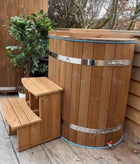
A sauna plus an ice bath. This is the classic setup and, for most, the best. A good sauna gives you steady, repeatable heat; a chilled ice bath holds a precise cold temperature with no ice runs at six in the morning. For a home or garden, our Solstice Snug Sauna pairs neatly with the Helix Ice Bath — Round and Oval, and if you want the heat built to your exact space, our Custom Saunas are made to measure. For clubs, studios and teams putting several people through, the Helix XL Team Ice Bath is sized and filtered for shared, repeated use.
Or a single combined unit. If floor space is tight — a smaller garden, a compact recovery room — a unit that does both hot and cold in one footprint saves you the second installation. Our Helix Duo — Hot Tub and Ice Bath is built for exactly this: proper heat and proper cold in a single machine, which makes the whole contrast cycle a matter of stepping from one side to the other.
If you'd like to go deeper into the evidence first, our Science Lab on contrast therapy lays it out, and if you'd rather talk through what actually fits your space and your use, you can book a call and we'll be honest about it — including when a simple ice bath on its own would serve you just as well.
The honest sign-off
Contrast therapy is a genuinely lovely thing that has been slightly oversold. The alternating hot and cold will not mechanically pump waste from your muscles — the temperature swings don't even reach them — and as a recovery tool it performs about as well as a plain cold plunge, no better. What it will do is reliably ease soreness, reliably leave most people feeling clear-headed and cheerful, and turn recovery into a ritual people genuinely look forward to, which is no small thing. It won't cure anything. Done sensibly, with a doctor's nod if you need one, it will probably make a lot of your mornings better. Finish on cold, breathe on the way in, and enjoy the slightly ridiculous pleasure of it.
Sources
- Laukkanen T, Khan H, Zaccardi F, Laukkanen JA. Association between sauna bathing and fatal cardiovascular and all-cause mortality events. JAMA Internal Medicine, 2015. link
- Myrer JW, Draper DO, Durrant E. Contrast Therapy and Intramuscular Temperature in the Human Leg. Journal of Athletic Training, 1994. link
- Higgins D, Kaminski TW. Contrast Therapy Does Not Cause Fluctuations in Human Gastrocnemius Intramuscular Temperature. Journal of Athletic Training, 1998. link
- Bieuzen F, Bleakley CM, Costello JT. Contrast Water Therapy and Exercise Induced Muscle Damage: A Systematic Review and Meta-Analysis. PLOS ONE, 2013. link
- Bleakley C, McDonough S, Gardner E, Baxter GD, Hopkins JT, Davison GW. Cold-water immersion (cryotherapy) for preventing and treating muscle soreness after exercise. Cochrane Database of Systematic Reviews, 2012. link
- Versey NG, Halson SL, Dawson BT. Water immersion recovery for athletes: effect on exercise performance and practical recommendations. Sports Medicine, 2013. link