Ice Baths: What the Science Actually Says (And How to Choose One)
Why would anyone voluntarily climb into freezing water? An honest, warmly told tour of what cold-water immersion actually does to the body, where the evidence is strong and where it's been oversold, how cold and how long is sensible, and how to choose an ice bath for home or a commercial recovery floor.
There is a particular face people make in the first three seconds of an ice bath. It is the face of someone who has just remembered, far too late, that this was entirely their own idea. The jaw clamps, the breath leaves in a sort of startled whoop, and for a moment the whole of human history — fire, agriculture, central heating — seems like a colossal waste of effort. And then, thirty seconds later, something rather lovely happens. The panic recedes. The breathing slows. And you climb out feeling, against all reason, magnificent.
Cold water has become one of the great wellness obsessions of the age, which is exactly the sort of thing that should make a sensible person suspicious. Whenever everyone agrees that a thing is miraculous, it is usually neither as miraculous nor as useless as the two loudest camps insist. So let's do something unfashionable and look at what the evidence actually says — the good, the overcooked, and the genuinely worth-knowing — before we get anywhere near the business of choosing a tub to sit in.
What actually happens when you get in
The first thing to understand is that cold water is not a gentle nudge to the nervous system. It is a full-blown alarm. The instant cold hits your skin, you get what physiologists rather undramatically call the cold shock response: an involuntary gasp, a burst of rapid breathing, a jump in heart rate and blood pressure, and a great squeeze of the blood vessels near the surface of your skin. This is not a mystical cleansing. It is a two-to-three-litre gulp of air you did not ask for, and it peaks within the first thirty seconds before settling over a few minutes (Datta & Tipton, Journal of Applied Physiology, 2006).
That gasp is also why cold water, in the wrong setting, kills people — more on that shortly. But in a controlled tub, chest-deep, with someone sensible nearby, it is simply the body doing exactly what three hundred million years of evolution built it to do, which is to take alarming new information extremely seriously.
Underneath the drama, the chemistry is genuinely interesting. One frequently cited study found that immersion in 14°C water sent plasma noradrenaline up by around 530% and dopamine by around 250%, alongside a sharp rise in metabolic rate (Šrámek et al., European Journal of Applied Physiology, 2000). That is a real, measurable jolt of the body's own stimulants. It is also where a good deal of the overclaiming begins, because a surge of a chemical in your bloodstream is not the same as that chemical reshaping your brain — a distinction the enthusiasts tend to skate over, and one worth hanging on to.
What the evidence supports — and what's been oversold
Muscle soreness and recovery: a genuine, if modest, win. This is the strongest card cold water holds. Pooled analyses of dozens of trials find that cold-water immersion after hard exercise reliably reduces that deep, two-days-later ache (delayed-onset muscle soreness) and lowers markers of muscle damage in the blood (Wang et al., network meta-analysis, Frontiers in Physiology, 2025; Machado et al., Sports Medicine, 2016). It makes you feel less wrecked, which if you are racing again tomorrow is not nothing. What it does less convincingly is actually restore strength or power faster — the effect on how hard you can push the next day is thin (Zhu et al., strength-recovery meta-analysis, PeerJ, 2026).
The plot twist every lifter should know. Here is the caveat the cold-plunge crowd rarely puts on the poster. If your goal is building muscle and strength, routinely jumping into cold water straight after lifting may be quietly working against you. In a now-famous twelve-week study, men who did cold-water immersion after every resistance session gained less muscle and strength than men who did a gentle active recovery instead — the cold appeared to blunt the very signalling that tells muscle to grow (Roberts et al., The Journal of Physiology, 2015). So the same tool that helps a footballer back up for Saturday may hobble a bodybuilder chasing size. Timing and purpose matter enormously. If you have trained specifically to grow, it's wise to leave a few hours — or a rest day — between the barbell and the bath.
Mood and alertness: real, but keep your head. Most people climb out feeling sharper and brighter, and this one isn't just folklore. A small brain-imaging study found that a five-minute cold immersion increased positive feelings — more alert, more attentive — and nudged the connectivity between brain networks handling attention and emotion (Yankouskaya et al., Biology, 2023). A separate study of a single open-water dip found a measurable lift in mood (Kelly & Bird, Lifestyle Medicine, 2022). These are encouraging. They are also small, short-term, and a long way from a prescription. The honest summary is that cold water seems to give many people a reliable, pleasant jolt of feeling-good-and-awake — which, for a glorified cold bath, is a perfectly respectable thing to offer.
Depression, metabolism and brown fat: here the evidence is thinner than the enthusiasm. You will have heard that cold water treats depression, melts fat and overhauls your metabolism. Tread carefully. There is a widely shared case report of one woman whose depression improved markedly with open-water swimming (van Tulleken et al., BMJ Case Reports, 2018), and a small feasibility study pointing the same hopeful direction — but these are early, tiny, and not the kind of thing you'd bet a treatment plan on (Hjorth & Rasmussen, feasibility study, European Psychiatry, 2024). On metabolism: cold exposure can activate brown fat and improve some metabolic markers, but that work largely involves sustained, repeated cold acclimation over weeks, not a brisk three-minute plunge, and researchers themselves describe the health claims as still genuinely debated (Espeland et al., International Journal of Circumpolar Health, 2022). A large 2025 review of cold-water immersion for health and wellbeing reached much the same verdict: some promising signals, mostly modest and short-lived, on a shaky evidence base (Cain et al., PLOS ONE, 2025). Cold water may yet prove to do more. It simply hasn't proved it yet.
How cold, how long, how often
The reassuring news is that you don't need to approach absolute zero to get the benefit. The soreness-and-recovery trials cluster around a sensible range: roughly 10 to 15°C for 10 to 15 minutes works well for easing muscle soreness, while slightly colder water (around 5 to 10°C) for a similar spell may edge ahead for the blood markers (Wang et al., 2025; Machado et al., 2016). Colder and longer is not automatically better; it is mostly just more unpleasant and, past a point, riskier.
For a general feel-good, wake-up routine, most people settle on two to four minutes a few times a week. Start warmer and shorter than you think you need to, breathe slowly on the way in to tame that gasp reflex, and build up. The cold shock response genuinely does habituate — your body learns the trick and stops panicking so hard after a handful of sessions.
A serious word on safety. That first gasp is the reason cold water deserves respect. Never immerse alone, never combine it with alcohol, and get out if you start shivering uncontrollably or feel unwell. The cold shock response is a real cardiovascular stressor — if you have a heart condition, high blood pressure, are pregnant, or have any medical condition at all, talk to your doctor before you start. This article is about wellbeing and recovery; it is not medical advice, and cold water is not a treatment for any disease.
So how do you actually choose an ice bath?
Here is where a lot of the romance meets a lot of plumbing. A bin of water and a bag of ice from the garage will, technically, get you cold. It will also leave you hauling melting ice about at six in the morning, never quite sure what temperature you're in, and sharing your bathwater with whatever was last on your skin. For anything beyond the occasional dabble, a handful of unglamorous features are what separate a good decision from a regretted one.
Temperature control and the chiller. This is the single thing that turns cold water from a chore into a routine. A built-in chiller holds a precise, repeatable temperature — the same 11°C every morning, no ice runs, no guesswork. If you want to train the same dose consistently (and the evidence above is all about dose), a reliable chiller is the part that matters most.
Filtration and sanitisation — especially if you're sharing. Cold water slows bacteria; it does not sterilise anything. For a single home user this is manageable, but the moment more than one body is getting in — a household, a team, a studio — you need proper filtration and a sanitisation system, or you're running a shared petri dish. For any commercial setting this isn't optional, it's the whole ballgame.
Size, build and setting. Be honest about the body in the bath and the space around it. A solo tub for a garden is a very different object from a unit built to take a rugby squad through on a wet Tuesday. Build quality — insulation, the pump, the shell — is what decides whether you're still using it in five years or apologising to it.
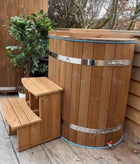
If you're kitting out a home, our Helix Ice Bath — Round and Oval is built around exactly that precise, no-ice-runs chiller control. For clubs and teams putting several athletes through, the Helix XL Team Ice Bath is sized and filtered for shared, repeated use. And if you'd rather have hot and cold in one footprint — for proper contrast work — the Helix Duo — Hot Tub and Ice Bath does both. If you want to go deeper into the evidence first, our Science Lab on cold-water immersion lays it out, and if you'd like to talk through what actually fits your space and your use, you can book a call and we'll be honest about it.
The honest sign-off
Cold water is not magic, and it is not snake oil. It is a genuinely useful, slightly ridiculous, surprisingly moreish thing that reliably eases sore muscles, reliably makes most people feel more awake and cheerful, and may do rather more that the science hasn't yet pinned down. It won't cure anything. It will, done sensibly, probably make a lot of your mornings better. And there is something quietly worth having in voluntarily doing a hard thing before breakfast and discovering you're still standing. Just breathe on the way in — and if your doctor says wait, wait.
Sources
- Datta A, Tipton M. Respiratory responses to cold water immersion: neural pathways, interactions, and clinical consequences awake and asleep. Journal of Applied Physiology, 2006. link
- Šrámek P, Simecková M, Janský L, Savlíková J, Vybíral S. Human physiological responses to immersion into water of different temperatures. European Journal of Applied Physiology, 2000. link
- Roberts LA, Raastad T, Markworth JF, et al. Post-exercise cold water immersion attenuates acute anabolic signalling and long-term adaptations in muscle to strength training. The Journal of Physiology, 2015. link
- Machado AF, Ferreira PH, Micheletti JK, et al. Can Water Temperature and Immersion Time Influence the Effect of Cold Water Immersion on Muscle Soreness? A Systematic Review and Meta-Analysis. Sports Medicine, 2016. link
- Wang H, Wang L, Pan Y. Impact of different doses of cold water immersion (duration and temperature variations) on recovery from acute exercise-induced muscle damage: a network meta-analysis. Frontiers in Physiology, 2025. link
- Zhu Y, Yang L, Liu T, et al. Temporal dynamics of muscle strength recovery following acute cold-water immersion: a systematic review and meta-analysis. PeerJ, 2026. link
- Yankouskaya A, Williamson R, Stacey C, et al. Short-Term Head-Out Whole-Body Cold-Water Immersion Facilitates Positive Affect and Increases Interaction between Large-Scale Brain Networks. Biology, 2023. link
- Kelly JS, Bird E. Improved mood following a single immersion in cold water. Lifestyle Medicine, 2022. link
- van Tulleken C, Tipton M, Massey H, Harper CM. Open water swimming as a treatment for major depressive disorder. BMJ Case Reports, 2018. link
- Hjorth P, Rasmussen MRV. Cold water swimming as an add-on treatment for depression: a feasibility study. European Psychiatry, 2024. link
- Espeland D, de Weerd L, Mercer JB. Health effects of voluntary exposure to cold water – a continuing subject of debate. International Journal of Circumpolar Health, 2022. link
- Cain T, Brinsley J, Bennett H, et al. Effects of cold-water immersion on health and wellbeing: A systematic review and meta-analysis. PLOS ONE, 2025. link