The Best Ice Bath for You (UK): An Honest Buyer's Guide
There is no single best ice bath — only the best one for who's getting in and where. An honest, jargon-free UK buyer's guide to what actually matters (reliable chiller control, filtration, size and build), with Helix's own range matched to home, teams and contrast use.
Everyone, quite reasonably, wants the best. We type it into search bars dozens of times a day — the best laptop, the best running shoe, the best pub within walking distance of here. It's a sensible instinct. The trouble with ice baths is that the honest answer to "which is the best?" is the single most annoying answer in all of shopping: it depends. It depends almost entirely on who is getting in, how often, and where on earth you're going to put the thing.
So let's not pretend otherwise. There is no universal best ice bath, in the way there is no best pair of shoes for every foot and every occasion. There is, however, a best ice bath for you — and finding it is far less mysterious than the marketing would have you believe. It comes down to a short list of things that genuinely matter, and a bit of plain honesty about your own situation. This is a guide to both.
What actually separates a good ice bath from a bin of water
Here is a slightly deflating truth to begin with: a wheelie bin, a hose and a few bags of supermarket ice will, technically, get you cold. People do exactly this, and for the first fortnight it feels marvellously rugged. The romance tends to wear off at about the same rate as the ice, usually around a wet Tuesday in February, when you're hauling melting bags from the garage at six in the morning and still have no real idea what temperature you're sitting in.
What separates a proper ice bath from a cold bin, then, is mostly the unglamorous engineering that makes the cold reliable and repeatable. A handful of features do the heavy lifting:
A proper chiller, and the temperature control that comes with it. This is the single most important part, and it's worth understanding why. Almost everything we know about cold water working — for easing muscle soreness, for that reliable lift in mood and alertness — is about dose: a sensible temperature held for a sensible time, done consistently. The recovery research clusters around roughly 10–15°C for a few minutes, repeated regularly, rather than one heroic plunge into near-freezing water (we lay the evidence out properly in our science and how-to-choose guide). A built-in chiller is what lets you actually train that dose — the same 11°C every single morning, no ice runs, no guesswork. Without one, you're not really doing a protocol; you're having a slightly different cold bath each day and hoping.
Filtration and sanitisation. Cold water slows bacteria down; it does not sterilise anything. For one person dipping at home this is manageable with a bit of sense. But the moment a second body gets in — a household, a team, a studio full of members — untreated water becomes a shared petri dish rather quickly. Proper filtration and a sanitisation system stop that. For anything beyond solo use this isn't a nice-to-have; it's the whole point.
Size and capacity. Be honest about the body in the bath and the bodies waiting their turn. A neat solo tub for one person's garden is a completely different object from a unit built to put a rugby squad through on a Saturday. Too small and you'll resent it; too large and you'll pay to chill water nobody's using.
Build quality and insulation. This is what decides whether you're still happily using the thing in five years or quietly apologising to it. Good insulation keeps the chiller from working itself to death (and keeps your electricity bill civil). A solid shell, a decent pump and sensible materials are the difference between a considered purchase and an expensive paddling pool.
Indoor or outdoor, and how much faff it is to run. Where it lives changes what you need — drainage, power, weatherproofing, whether it needs to look handsome in a treatment room or merely survive a Pennine winter. And the honest question underneath all of it: how much maintenance are you actually going to keep up with? The best ice bath is, in the end, the one you'll still be getting into in six months.
Now match it to you
With all that in mind, here's how it tends to shake out in practice. Find the description that sounds most like your life.
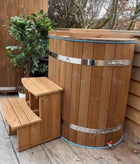
If it's you, at home, most mornings. You want one reliable, precise, private plunge without the ritual of the ice run. This is exactly what the Helix Ice Bath — Round and Oval is built around: a proper chiller holding the temperature you set, day after day, so the only variable left is whether you can be bothered — which, pleasingly, gets easier the more you do it. Round or oval depending on how you like to sit and the space you've got.
If it's a team, a gym or anywhere high-volume. Several people, in and out, repeatedly, week after week. Here the two things that matter most are capacity and water hygiene, because a shared tub without real filtration is a problem waiting to happen. The Helix XL Team Ice Bath is sized and filtered precisely for that — built for shared, repeated use rather than a quiet solo dip.
If you want hot and cold in one footprint. Perhaps you're drawn to contrast work — alternating hot and cold — or you simply haven't the room for two separate units. The Helix Duo — Hot Tub and Ice Bath does both in a single footprint, which is a tidy answer to a common space problem.
If it's a commercial or bespoke install. A clinic, a spa, a members' club, a performance floor — somewhere the unit has to meet a brief, fit a space and stand up to serious daily use. That's its own conversation, and we've set out how we approach it on our commercial ice baths page.
A quick, honest word on the DIY bin
None of this is to sneer at the ice-and-bin brigade. If you genuinely want to find out whether cold water is for you before spending real money, a cheap tub and a few bags of ice is a perfectly sensible experiment, and we'd rather you tried it than talked yourself out of the whole idea. Just go in with clear eyes: you won't know your exact temperature, you'll spend on ice what you'd save on kit, the water hygiene is entirely on you, and the daily faff is the reason most DIY setups end up as very cold planters by spring. A chilled unit isn't about luxury so much as about removing the excuses — which, for a habit that only works if you keep it, turns out to matter enormously.
Frequently asked questions
How much does an ice bath cost? It ranges a great deal — from a budget DIY tub up to a fully plumbed commercial installation — so rather than pluck a figure from the air, we've written it up honestly in our guide to what a commercial ice bath costs in the UK, which also helps make sense of home pricing.
Home or commercial — which do I need? If it's one or two people at home, a home unit is right. The moment you're putting several people through regularly — a team, a studio, paying members — you want commercial-grade capacity and filtration, because shared water and daily use are a different engineering problem.
Do you deliver and install? Yes. Delivery and installation vary by unit and by site, especially for larger and commercial setups, so the simplest thing is to book a call and we'll talk through your space and what's involved.
How cold should it actually be? For easing muscle soreness and a general feel-good routine, the evidence points to roughly 10–15°C for a few minutes, done consistently, rather than the coldest water you can bear. We explain the how-cold-how-long question in full in our science guide. As ever, this is about wellbeing and recovery, not treating any medical condition — and if you've a heart condition, high blood pressure, are pregnant, or have any health concern at all, check with your doctor first.
The honest sign-off
So, the best ice bath. It's the one that fits the person getting in, holds its temperature without a fuss, keeps its water clean for however many people use it, and is still being used long after the novelty's worn off. For most people at home that's the Round and Oval; for teams it's the XL; for hot-and-cold in one it's the Duo; and for anything bigger or bespoke, that's a proper conversation. If you'd like us to be honest with you about which actually fits your space and your use — including telling you if you don't need our fanciest option — book a call. We'd genuinely rather you bought the right one once.
Sources
- Machado AF, Ferreira PH, Micheletti JK, et al. Can Water Temperature and Immersion Time Influence the Effect of Cold Water Immersion on Muscle Soreness? A Systematic Review and Meta-Analysis. Sports Medicine, 2016. link
- Wang H, Wang L, Pan Y. Impact of different doses of cold water immersion (duration and temperature variations) on recovery from acute exercise-induced muscle damage: a network meta-analysis. Frontiers in Physiology, 2025. link